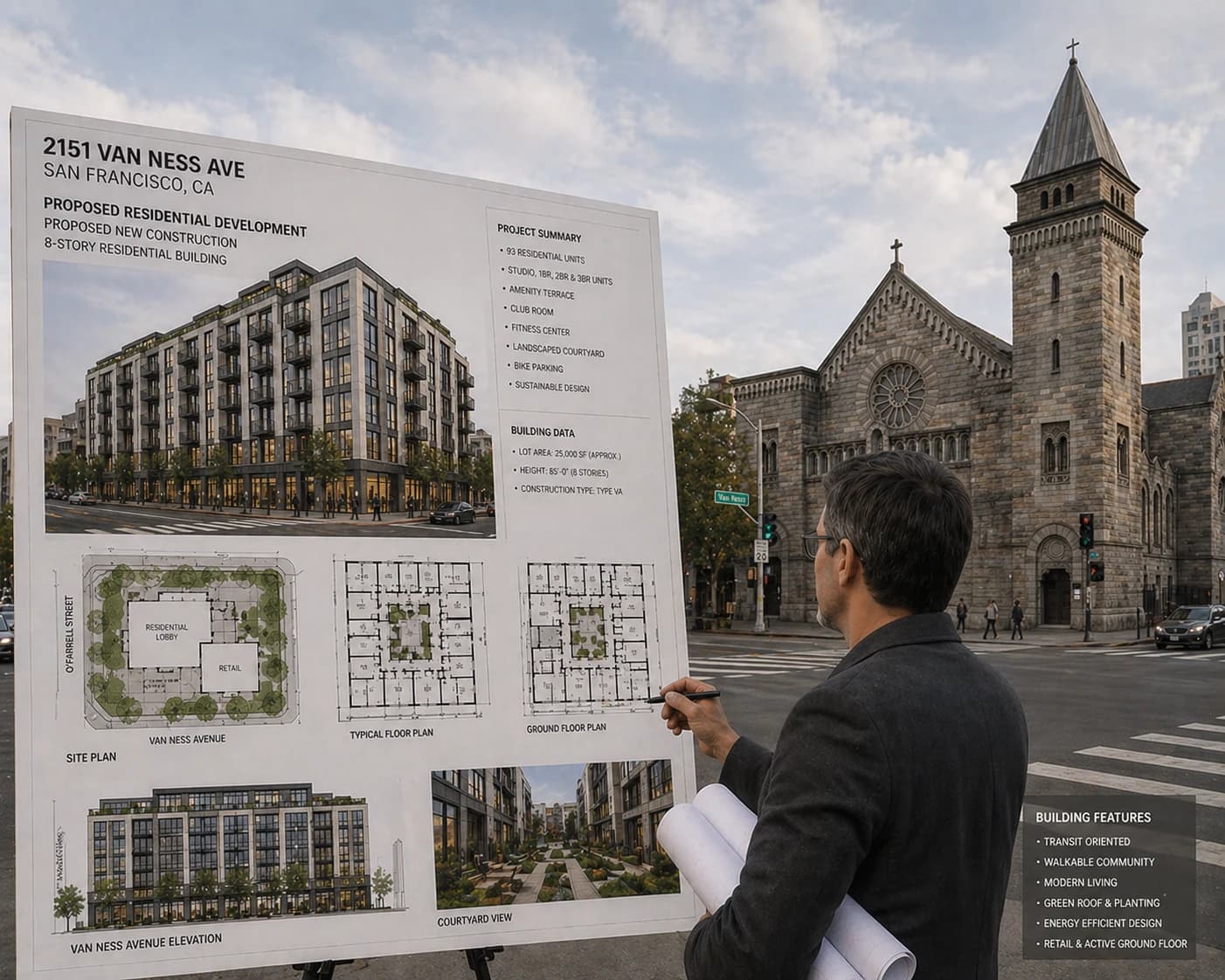
Property Report: Ground-Up Construction Feasibility at 2151 Van Ness Ave, San Francisco, CA
History
The Academy of Art University has sold a historic San Francisco landmark as part of its broader effort to reduce its real estate holdings. St. Brigid Church, located at 2151 Van Ness Ave., was sold for $4.7 million to a buyer linked to Fremont-based real estate firm JLA Home.
The century-old building, designated as a city landmark, spans approximately 20,000 square feet and has survived both the 1906 and 1989 earthquakes. Known for its soaring ceilings, pipe organ, and unique façade built from repurposed street stones, the church was restored by the university after its $3.7 million purchase in 2005 and later used as an auditorium.
The sale raises questions about the future of the site, including potential residential redevelopment, subject to zoning and historic preservation considerations.
Executive Summary
This advisory report evaluates the feasibility of ground-up construction for a residential apartment building at 2151 Van Ness Ave, San Francisco, CA 94109. The property, currently a church, is located in a high-density residential-commercial zone (RC-4) and is subject to specific zoning regulations and historic preservation requirements. The analysis concludes that while the project is feasible, it will require careful navigation of zoning regulations, historic resource evaluations, and compliance with the California Environmental Quality Act (CEQA).
Property Overview
- Address: 2151 Van Ness Ave, San Francisco, CA 94109
- Jurisdiction: San Francisco, California
- Current Use: Church
- Zoning Designation: RC-4 (Residential-Commercial, High Density)
- Height/Bulk District: 80-D (Maximum height of 80 feet)
- Special Use District(s): Van Ness, Family and Senior Housing Opportunity SUD
- Historic Designation: Known Historic Resource (CEQA Category A)
Parcel Characteristics
The property is situated in a high-density area, designated for mixed-use development, allowing for substantial residential and commercial structures. The existing structure is a church, which is not tenant-occupied, providing a blank slate for redevelopment.
Regulatory Analysis
Zoning and Permitted Uses
RC-4 District: This zoning designation supports high-density residential and commercial development. Residential use is permitted without a density maximum set by lot area, constrained instead by the physical envelope of the building, including height, bulk, and setback requirements.
- Permitted Uses: Residential apartments are allowed. The district encourages a mix of residential and commercial uses, with a minimum residential to non-residential ratio of 3:1 in the Van Ness Special Use District (SUD).
- Conditional Uses: Any deviation from the prescribed use or density may require a Conditional Use Authorization (CUA).
Van Ness Special Use District (SUD): This district mandates substantial new housing developments, enforcing a minimum 3:1 residential to commercial floor area ratio. Developers can offset some requirements through in-lieu fees or by providing affordable on-site units.
Development Standards
- Height Limit: 80 feet maximum as per Height/Bulk District 80-D.
- Bulk Controls: Governed by Planning Code Section 270, which dictates building massing and envelope parameters.
- Setbacks and Open Space: Setbacks above 50 feet and rear yard waivers are possible through variance if open space equivalence is maintained.
Historic Resource Considerations
The property is classified as a Known Historic Resource under CEQA Category A. This designation requires:
"Full historic resource evaluation (HRER) and compliance with CEQA. Alternatives analysis and possibly an Environmental Impact Report (EIR) are mandatory."
Affordable Housing Requirements
- Unit Mix: For developments of five or more units, at least 40% must be two-bedroom units or larger.
- Inclusionary Housing: Significant affordable housing must be included, either on-site, off-site, or through in-lieu fees.
Ground Floor Activation
Projects facing Van Ness Avenue must incorporate active, pedestrian-oriented ground-floor commercial uses, such as retail or restaurants, to enhance street-level engagement.
Feasibility Assessment
Allowed Development
- Residential Construction: Permitted under RC-4 zoning, with adherence to height and bulk standards.
- Commercial Component: Required to maintain a minimum 3:1 residential to commercial ratio.
Required Approvals
- Historic Resource Evaluation: Necessary due to the property's historic designation.
- Conditional Use Authorization: Likely required for changes in use or density beyond standard allowances.
- Environmental Review: A full Environmental Impact Report (EIR) may be needed due to the historic status.
Prohibited or Infeasible Actions
- Demolition without Approval: Significant alterations or demolition of the historic structure without proper evaluation and approvals are prohibited.
Key Findings & Recommendations
- Engage Historic Preservation Experts: Early consultation with specialists in historic property entitlement and CEQA compliance is crucial to navigate potential challenges.
- Pre-Application Meeting: Schedule a meeting with San Francisco Planning to discuss the project scope and obtain feedback on the permitting process.
- Architectural Planning: Commission studies for architectural massing and floor plans to ensure compliance with zoning and historic preservation requirements.
- Affordable Housing Strategy: Develop a plan for meeting affordable housing obligations, considering both on-site provision and in-lieu fee options.
- Community Engagement: Engage with local stakeholders and community groups to address potential concerns and gain support for the project.
Permit & Approval Roadmap
Steps and Agencies
- Historic Resource Evaluation (HRER): Conducted by a qualified consultant, reviewed by San Francisco Planning.
- Environmental Review (EIR): Required due to historic status, potentially involving a lengthy review process.
- Conditional Use Authorization (CUA): Application submitted to the Planning Commission for approval.
- Site/Building Permit: Obtained post-entitlement, following approval of all necessary evaluations and authorizations.
- Variances: Applied for as needed, particularly for setbacks or open space requirements.
Estimated Timelines
- Historic Resource Evaluation: 3-6 months
- Environmental Review: 6-12 months
- Conditional Use Authorization: 3-6 months post-EIR
- Total Project Timeline: 18-24 months from initial application to groundbreaking
Conclusion
The proposed ground-up construction of a residential apartment building at 2151 Van Ness Ave is feasible, provided that the project adheres to zoning regulations and historic preservation requirements. The property owner should prioritize engaging with historic preservation experts and San Francisco Planning to ensure compliance and streamline the approval process. By addressing affordable housing obligations and integrating community feedback, the project can proceed successfully, contributing to the city's housing goals while respecting its historic context.